A TI-M message arrives.
The host presents the request in the staff workspace. The message alone does not start an audio call.
- A staff member reviews the request.
- The business process determines the next action.
A member request can span a service desk, a host application and TI-M, each with different responsibilities. A central contact center can use TI-M through a Headless module embedded locally in its backend. Staff work in their familiar interface; process routing, technical identity and the TI-M Pro provider receive clearly assigned responsibilities. MEMM describes the integration architecture and normative framework for a project-specific scope.
Staff access the host. Only the host invokes its local Headless module. This overview shows messaging integration; calling paths are described separately.
Walk through one requestAct as a member of staff: open a request, choose a response and follow the central audio path. Every action only changes this example on the page.
Reading view: the complete flow and its alternative outcomes follow below.
The host presents the request in the staff workspace. The message alone does not start an audio call.
Offer an audio conversation or continue in writing. Choosing audio prepares an invitation; the other participant still needs to accept.
This successful example assumes the required checks have passed. Headless exchanges the call signalling; audio begins only after the peer accepts and the protected media path is established.
TI-M E2EE protects media between the peer and Headless in the server. The trusted host handles plaintext audio and carries it to staff over the separate WSS/TLS channel.
The illustrated teardown stops media, releases the call lease and clears temporary media buffers. Staff can then record the business outcome in their host workflow.
Audio does not start. The host shows the reason, and Headless does not fall back to a direct connection or external UDP path.
The host presents a prepared example response. No call invitation or audio session is created.
“We can answer your general question here in the chat.”
The example ends with a written response. No call was opened, and no media lease or audio recording was created.
Explore the identity model, employee ownership, BPMN case, approval boundary and possible Matrix outcomes in one fully synthetic process.
A messaging channel alone is not enough. Identity, allowed attributes, room context, error semantics and ownership between host, automation and external services must be named.
Only eligible healthcare organizations may integrate and operate Headless. Medical data serves healthcare delivery or its organization; multipurpose systems protect it from unrelated access (A_28725, A_28733).
An individual, a functional account managed by people, and an automated account have different FHIR VZD codes. Conversation partners must be able to recognize a chatbot as such.
The organization administrator manages the mandatory de.gematik.user.orgname field and optional additional attributes. Profile information supports identification; authorization checks remain a separate contract (A_30013, A_30014).
The TI-M Pro provider documents the system, manufacturer and architecture, reviews its manual at least every six months, and obtains GTI approval before integration and for material changes (A_28681, A_28682, A_28849, A_28850).
This chat and host model follows the gematik example in section 3.3.4. For Calling, the ITL design below additionally defines the media and TLS endpoints; the gematik example alone does not specify a central real-time audio transport.
Even localhost REST, TCP or WebSocket is prohibited as the Headless module API (A_28651). The host may expose its own TLS-secured network interfaces (A_28734). The provider must not bridge directly or indirectly into other messenger systems (A_28683).
For this reference design, ITL places Matrix signalling, PeerConnection and DTLS-SRTP keys inside the Headless module. The host supplies the user interface and permitted media input/output through local function calls. TI-M Basis 1.3.0 lists VoIP as an optional module; the concrete division below is an ITL decision. It defines the selected architecture and acceptance criteria, not an already exercised media runtime or gematik approval.
One active call per local account/device context, two TI-M devices and a private encrypted room with two users. Several devices of one user may receive an invite; selection of the answering device determines the media peer. Multiparty conferencing, MCU/SFU, SIP/PSTN and messenger bridging are outside this design. [3] [5] [2]
Profile B is selected for the central contact-center path: the TI-M media endpoint is the server-side Headless module. The operator device has a separate authenticated TLS connection to the host. If E2EE must reach the operator device, select profile A at the workstation while keeping chat and business-process management central.
The native host and Headless module run in the controlled process at the operator workstation. Headless holds PeerConnection and Matrix/media keys; the host supplies consent, microphone/camera, playback and visible controls. PCM/image data passes through the local function boundary. The host is therefore a trusted plaintext participant; E2EE does not protect against it or a compromised platform. The external media route must also meet the TURN/TLS profile below. [2] [9]
The host and Headless module run together on the central server. TI-M E2EE ends there. An authenticated operator device carries audio over the host’s own WSS/TLS 1.3 channel; only the host’s local functions invoke Headless. The host may process the permitted audio in the defined healthcare workflow. The WSS leg is a separate transport, not continuation of the same TI-M E2EE and not a Headless network API. Video, recording and transcription are not enabled in this first central profile. [2] [9]
Choose where the Headless module runs. That choice determines where TI-M media is decrypted and how staff access the conversation.
The TI-M endpoint is the Headless module at the staff workstation.
Interface, microphone and speaker
TI-M E2EE endpoint in the local moduleThe other participant’s device
The other TI-M E2EE endpointThe trusted local host handles permitted plaintext audio/video input and output. Media keys stay in Headless and the peer endpoint.
The TI-M endpoint is the Headless module in the server. Staff connect to its host separately.
Authenticated access to the host
Separate operator connectionLocal module calls inside the process
TI-M E2EE ends in this moduleThe other participant’s device
The other TI-M E2EE endpointThe trusted server host handles plaintext audio. The operator leg has its own TLS protection; it is outside the TI-M E2EE session between Headless and the peer. Media keys are not exported to the operator.
Both profiles require the agreed route through one controlled TURN instance in one VM, with both client allocations over TLS and relay forwarding confined to that VM. If this cannot be verified, Calling remains unavailable.
Teal marks end-to-end media protection; blue marks each TLS transport leg. The full-size diagrams can be scrolled horizontally. The selected reference design and its runtime acceptance conditions are specified in ADR-001; runtime acceptance has not been run.
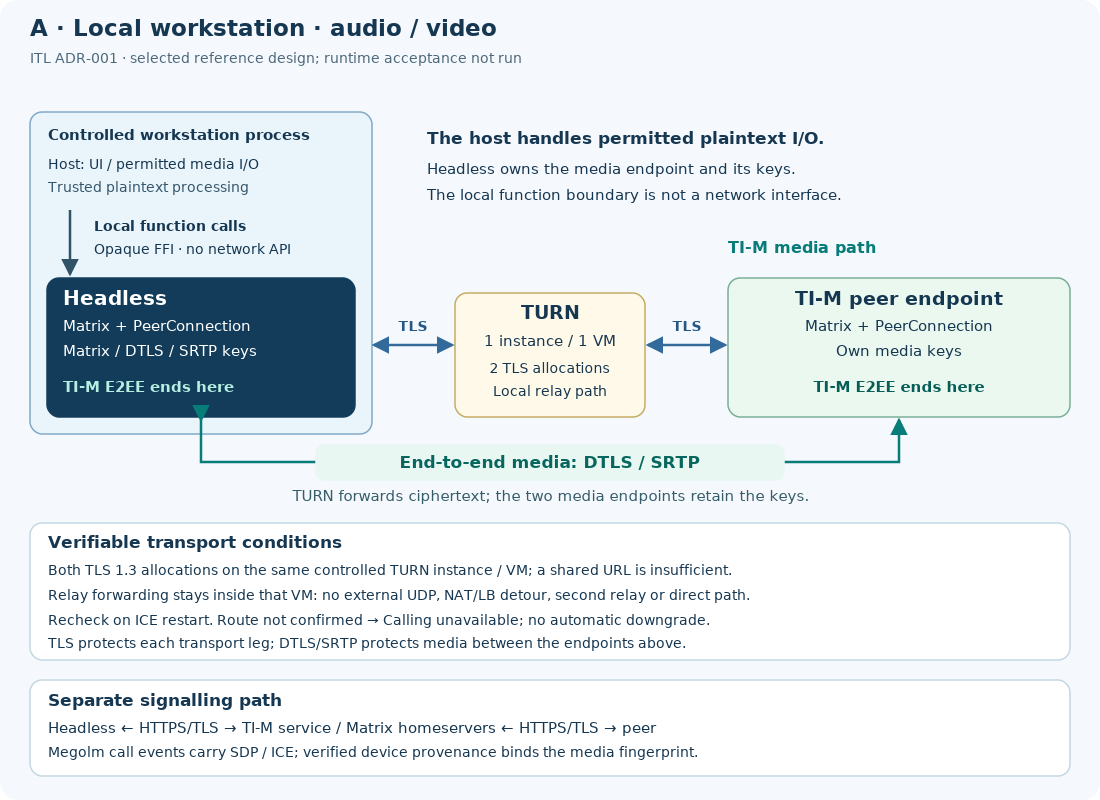
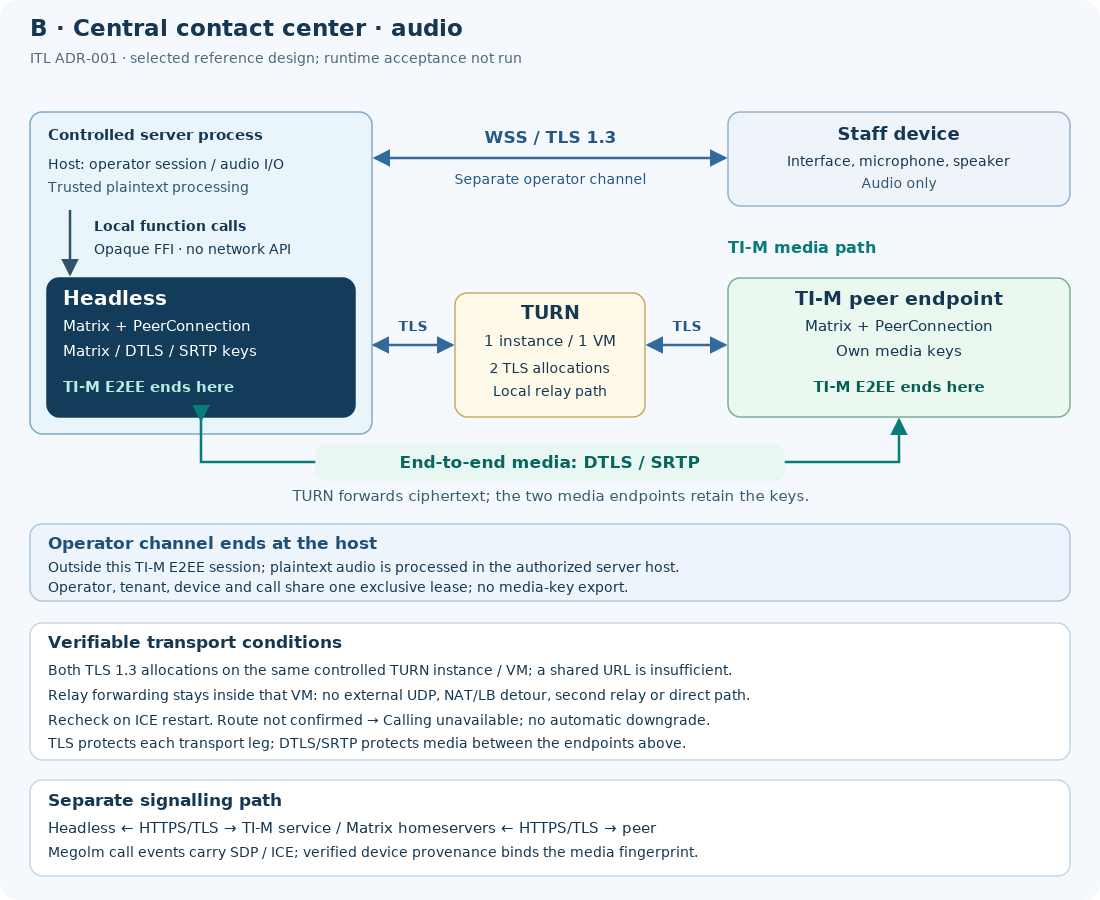
The TLS interpretation is deliberately narrow: no explicit VoIP exception to A_25299/A_25573 was found in the checked sources. The selected TURN profile is an engineering inference, not an official gematik interpretation. Its feasibility, peer compatibility and approval must be established for the actual deployment. Without an established path, the call is not admitted. [3] [4] [10]
On narrow screens, scroll this table horizontally.
| Responsibility / rule | Selected contract |
|---|---|
| Signalling · both profiles ITL decision | Host command → local Headless function → E2EE-protected Matrix room event over TLS to the TI-M service → peer. An answer takes effect only after validation of room, user, session origin, call and selected party. [5] [6] [3] |
| TI-M media · both profiles Engineering inference | Headless encrypts media for the selected peer device with SRTP/SRTCP. Packets travel inside TLS/TCP to its TURN allocation, pass to the peer allocation within the same controlled VM, and travel inside that allocation’s TLS/TCP connection to the peer device. ICE/DTLS packets use this same path; the TURN service receives no SRTP keys. [10] [11] [3] |
| Operator audio · profile B only ITL decision | Workstation capture → authenticated WSS/TLS channel → central host → local media function → Headless. Reception reverses the path: Headless decrypts → local media function → host → WSS/TLS → playback. Plaintext exists in the server module, authorized host and operator device. Host WSS does not carry TI-M DTLS/SRTP keys. [2] |
On narrow screens, scroll this table horizontally.
| Responsibility / rule | Selected contract |
|---|---|
| Opaque handles and bounded commands ITL decision | The local contract offers start/accept/reject/end, microphone/camera state, media I/O and subscribed status updates. Opaque handles are bound to tenant, account, device, call and generation; invalid or reused handles are rejected. The host receives no crypto objects, raw keys, generic network proxy or API to bypass event validation. The C ABI form is ITL design. [2] |
| Profile B · versioned WSS frame channel ITL decision | ITL reference profile v1: mono PCM16LE at 48 kHz in 20 ms blocks (1,920 audio bytes), with resampling in the trusted audio adapter. Each block carries channel ID, lease generation, direction, sequence and capture time; its server-side binding covers tenant, operator, account, device and call. Only the agreed size and sequence are accepted. Access tokens do not appear in the WebSocket URL; frames contain no TI-M keys. This is a contract definition, not a shipped transport. [2] |
| Profile B · exactly one authorized operator ITL decision | A server-side exclusive call lease prevents parallel media control of a shared Matrix ID. Reference values: authenticated heartbeat every 5 seconds, expiry after 15 seconds without valid renewal; audio buffering at most 200 ms per direction, then discard stale frames. WSS closure, revoked authorization or lease loss stops media and the call. Recording, persistent audio buffers and transcription are off by default; a change requires its own scope and change process. [2] |
Open the complete Calling architecture, states and acceptance criteria →
Download the R24.23 architecture contract as JSON ↓
The organization administrator sets the ConnectionType of the FHIR VZD Endpoint resource. This code identifies the contact type; it replaces neither role permissions nor review of the healthcare purpose.
| Contact | ConnectionType | Normative reference |
|---|---|---|
| Individual | tim | A_29024 |
| Functional account managed by people | tim-fa | A_25546 |
| Automated account / chatbot | tim-bot | A_25547; display name: Name (Chatbot) under A_25553 |
Primary source: gemSpec_TI-M_Pro 1.2.0, sections 5.2 and 5.4.1 ↗
Host login and Matrix account are separate mappings: section 3.3 describes both individual employee accounts in the host using one shared Matrix ID and personal Matrix accounts. The host and permission design therefore need to identify who acts in the business process; a technical Matrix ID alone does not establish an individual staff identity.
Insured users use TI-M Client ePA with TI-M Fachdienst ePA. Staff communicate through the contact center's professional Pro path. Access to the electronic patient record has a separate contract; a TI-M message does not grant record access.
TI-M Fachdienst ePA rejects profile queries without shared rooms with HTTP 403 and M_FORBIDDEN; /user_directory/search returns an empty result list. This does not give the contact center a general directory of insured users. TI-M ePA 1.3.1 · A_26290-01 / A_26375 ↗
Bound process, identity, attributes, room context, release and responsibility before implementation assumptions.
External gematik documents for architecture comparison. Listed profiles do not identify ITL as an approved manufacturer or operator.
TI-M ePA client product profile; its test scope differs from TI-M Pro and Headless.
Architecture boundary: Distinct TI-M ePA client
Provider responsibility for TI-Messenger ePA; distinct from TI-M Client ePA, the electronic patient record and the Headless module.
Architecture boundary: TI-M ePA provider / operations
TI-M Pro client product profile; not interchangeable with the TI-M Headless client module.
Architecture boundary: Distinct TI-M Pro client
Provider responsibilities for TI-M Pro; evaluate separately from the Headless module, Pro client and service.
Architecture boundary: TI-M Pro provider / operations
Requirement explanations follow the named external specifications; implementation and formal acceptance need separate, release-bound proof.
Selected requirements with a fixed source version. Open a topic for its responsibility, interface or data boundary.
The TI-M Pro Headless Client must expose an integration API and must provide neither its own end-user GUI nor a local or public network API. This includes localhost. The integrating system may expose its own network interfaces and must invoke the module only through its designated local functions; the provider secures integrating network connections with TLS. Rust, Flat C ABI and language bindings are ITL design choices within this requirement.
The TI-M Pro Headless Client must be the sole cryptographic endpoint of end-to-end encrypted communication. Key material, internal E2EE state and reconstructable security information remain within its protected context; diagnostic dumps must not expose them. For message encryption, TI-M clients require an audited Olm/Megolm implementation assessed as sufficiently secure. Basis names Vodozemac and libolm; other implementations require equivalent security evidence from qualified independent auditors. Cross-signing and Secure Secret Storage and Sharing (SSSS) for device verification must also be supported. Rust or a local ABI alone does not demonstrate that these requirements are met.
Headless operation requires effective process and access controls, approved software, and exclusion of unauthorized manipulation or debugging mechanisms. The provider restricts use to signed, tested and approved versions. Where technically possible, the integrator verifies the signature offline against a local trust anchor when loading the artifact and refuses execution on a verification error. Security-related rejections, state changes and misuse must be logged without alteration and with correct timing. Provider documentation must explain that external configuration or components must not suppress or manipulate these audit logs. A_28703 does not cover protection against a compromised platform or privileged administrators.
TI-M Basis lists VoIP as an optional module. Matrix 1.17 describes call signalling through room events and WebRTC with two devices per call. The current, not yet live-qualified calling design assigns Matrix E2EE, PeerConnection and DTLS-SRTP keys inside Headless; the host supplies controls and authorized local media I/O. This maps the architecture to the sole E2EE endpoint and isolation required by A_28710/A_28715. Locally, TI-M E2EE ends at the workstation module; centrally, at the server module with a separate TLS audio channel to the operator. The design is not a tested runtime or gematik approval.
A_25299 requires TLS between TI-M components across virtual/physical machine boundaries; A_25573 incorporates gemSpec_Krypt. No explicit VoIP exception was found in the checked sources. ITL therefore restricts the design to two TURN allocations over TLS/TCP on one controlled instance/VM with exclusively local relay forwarding. A turns URL and relay candidate alone do not establish the path; without assurance on both sides, Calling remains unavailable. This is a narrow engineering inference, not an official interpretation. General TLS 1.2 support is retained; TLS 1.3 is the choice for this media profile.
party_id identifies a call party but need not equal the Matrix device ID. Matrix 1.17 prohibits using outer Megolm sender_key/device_id fields to establish origin or index sessions. The design binds the validated user and device trust evidence through the validated session to room, call_id, party_id and SDP fingerprint. Media is released only after a matching DTLS handshake and an admitted relay path. Explicitly confirmed device trust before Calling is stricter ITL policy; TLS to the homeserver alone does not authenticate the media peer.
The TI-M Pro provider must not use the Headless Client directly or indirectly to bridge into other messenger systems. The Basis specification also prohibits server-side bridging into other messaging protocols. An internal product label for bridge state therefore does not establish a permitted TI-M bridge feature. Host process integration and permitted automation must respect this boundary.
The module manufacturer is responsible for the product type; the host manufacturer integrates the module into its system. The TI-M Pro provider assumes operating responsibility when offering the Headless product. On-premises operation must also be agreed with that provider. It records each integrating system, manufacturer and architecture in its operating manual and reviews this information at least every six months after approval. Before integration and for material changes, it must obtain approval from the party with overall TI responsibility (GTI) through the operational change process.
Headless integration and operation are restricted to systems of healthcare organizations entitled to order and use TI-M. Medical data may be processed only for healthcare delivery or its organization. Multipurpose systems need technical and organizational controls against unauthorized access by other organizational units. A contact center may assign chats within a healthcare workflow in its central host; this does not authorize unrelated use of the data.
The organization administrator classifies contacts in the FHIR VZD Endpoint resource: tim for an individual, tim-fa for a functional account managed by people, and tim-bot for an automated account. A chatbot adds (Chatbot) to its display name. The user profile requires de.gematik.user.orgname; orgtype, orgfachrichtung, orgaddress and beruf are optional additional fields. The organization administrator client offers matching FHIR VZD values for adoption. These profile attributes do not replace authorization checks.
The Headless Client must pass Matrix Client-Server API and TI-M specification error codes to the integrating system. A typed ITL contract must preserve their meaning. Diagnostic and stack text containing secrets can be redacted; a generic internal error enumeration must not replace the required protocol code. Security incidents may additionally require restricted outward diagnostics and protective action.
permissionConfig_V1.json defines the Pro permission configuration with defaultSetting and exceptions for servers, users or groups. TiMessengerInformation.yaml provides a separate HTTP information interface authenticated with a Matrix OpenID token: findByIk resolves an IK number to a server name; isInsurance checks its classification as an insured-user domain. The domain part of an MXID thus supports group assignment, not validation of an individual medical authorization. The Headless PTV pins both interfaces to commit a67678018fb06bff1c14e7a1347631587dc57db5. An ITL term such as Authorization must be mapped to these specific protocol contracts.
Insured users communicate through TI-M Client ePA and TI-M Fachdienst ePA. Professional users and the central contact-center host use the Pro product roles. TI-M ePA adds authentication through the sectoral insurer IDP using OIDC/PAR and directory search through /fdv/search. The client and service prevent public/knock join rules, world_readable history, public room-directory visibility and inactive encryption; the service rejects invalid room changes with HTTP 400 and M_INVALID_ROOM_STATE. Insured users receive no administration of other user accounts; the TI-M ePA proxy rejects invitations between two insured users in its client-server checks. Access to the electronic patient record has a separate ePA frontend and record-system contract.
TI-M ePA clients must support de.gematik.questionnaire.generic v1 and de.gematik.questionnaire.consent v1 on the receiving side: publish capabilities immediately after login, present received questionnaires with any prefilled values for completion, return final responses in a de.gematik.fhir event, and make completed questionnaires viewable later. This requirement applies to TI-M Client ePA. It does not establish an implemented MEMM questionnaire feature set or grant access to the electronic patient record.
Editorial source review: 17 October 2026. The mapping explains requirements; implementation verification and product approval have their own evidence.