C++20 / device workflow
HOST TESTEDC++ core, state machine, recovery and POC4 are supported by host tests.
Vendor-neutral embedded software foundation for point-of-care and laboratory instruments: C++20 workflow core, Rust OEM-worker source and testable fault boundaries. Designed to complement existing device architectures; real-time CAN integration remains a pilot objective.
Independent non-clinical ITL software foundation. C++/Python: host tested; Rust: source only, runtime pending. No CAN/PREEMPT_RT acceptance or clinical use.
For embedded diagnostic and laboratory instruments, clear integration boundaries, timing behavior, Rust/C++ interfaces and verifiable quality matter. This matrix separates the host-tested v0.11.0 functions from open OEM pilot work.
C++ core, state machine, recovery and POC4 are supported by host tests.
Independent Rust source available. rustc/Cargo and C++↔Rust runtime acceptance are not yet confirmed.
An asynchronous device worker has not been demonstrated. Ownership, scheduling, cancellation and backpressure are part of a proposed spike.
No real-time Linux acceptance: deadline, p99 latency, jitter, scheduling and load measurements on a target platform are pending.
No CAN hardware driver or medical sensor is integrated. Proposed scope: a bounded adapter with fault/timeout behavior.
Bearer token, segmented audit, fail-closed behavior and worker watchdog are host-tested. No device-production security qualification.
Architecture material and software tests exist. There is no claimed approved end-to-end traceability package or verified SAFe delivery process.
Architecture, requirements and test references exist as an engineering basis; OEM QMS, risk management and regulated verification remain open.
Evidence basis: ITL POC v0.11.0, public evidence catalog and a proposed non-clinical OEM pilot. Vendor and device interfaces are not considered compatible until separately tested. Evidence and criteria.
The C++ core and OEM workers remain separate. Explore each component and compare the Python/Rust adapters with their distinct evidence status.
Host integration tested
A concise view of the product architecture – alongside the interactive explorer above.
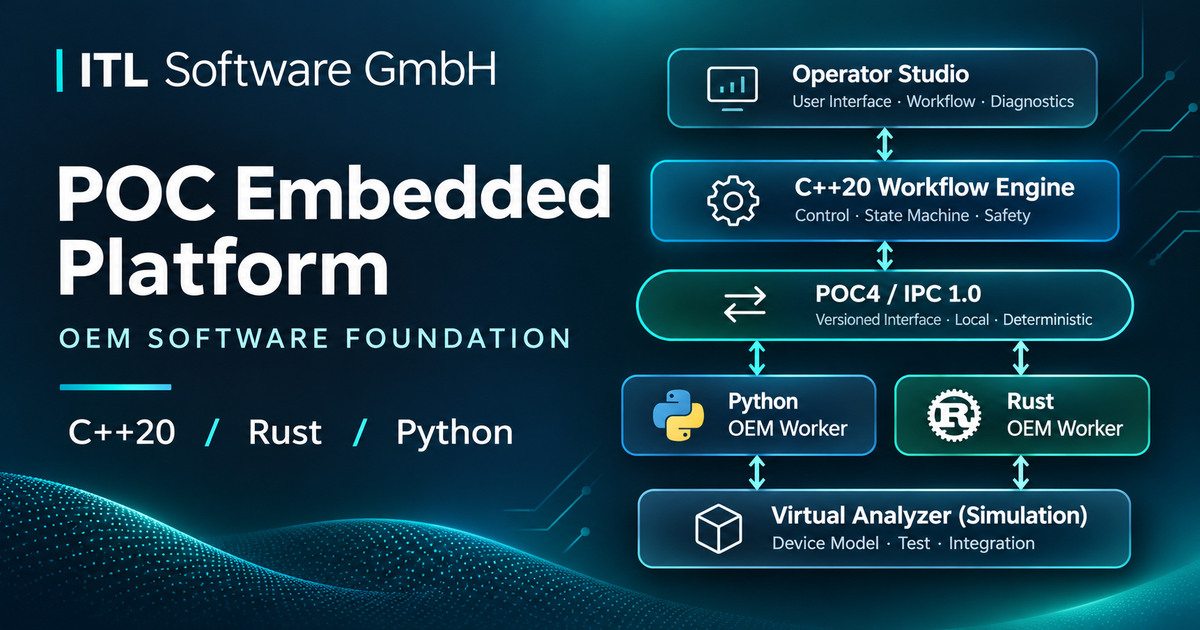
The C++/Python host is tested; independent Rust source exists but runtime acceptance is pending. All signals are synthetic.
Preflight, calibration, QC, synthetic run and controlled fault state.
Software demonstratorPOC4 / IPC 1.0 with host-tested Python worker and separate Rust source without external Cargo crates.
Software demonstratorSegmented events, exclusive writer lock and strict recovery without auto-resume.
Software demonstratorFail-closed handling of killed, unresponsive or mismatched workers.
Software demonstratorLocal Bearer-token-protected operator UI with event-driven SSE updates.
Software demonstratorSigned staging checks and simulated A/B logic; no real boot activation.
Software demonstratorThese scenarios run solely in your browser. They illustrate product logic and do not connect to the real C++ process or a medical sensor.
Ready for a new simulated workflow.
Next step starts the simulated self-test.
Figures reflect documented v0.11.0 host QA. Rust runtime tests were skipped due to missing toolchain; medical and hardware acceptance remain open.
Source: docs/QA_EVIDENCE.md, v0.11.0 (23 Nov 2026). The six sanitizer tests are selected groups, not a full 40/40 sanitizer run.
| Component | Evidence status | Test reference / boundary |
|---|---|---|
| C++20 Core | Host PASS | 40/40 GNU + 40/40 Clang · docs/QA_EVIDENCE.md |
| Operator UI / UTF-8 | Release check PASS | tests/ui_release_integrity.py · browser E2E pending |
| Python OEM Worker | Host integration PASS | tests/oem_cross_language.py · POC4 v1 |
| Rust OEM Worker | Source available · runtime SKIPPED | sdk/rust/ · tests/oem_rust_integration.py |
| Linux ARM64 VM | NOT TESTED | M1 VM acceptance not performed |
| Physical CM5 / HIL | NOT TESTED | No physical board or OEM sensors tested |
| IEC / IVDR | NOT VERIFIED | No medical-device conformity assessment |
Public summary of internal QA records; no private source, keys or test logs are distributed. Verified results apply to synthetic host software only.
Open public QA evidence and proposed pilot acceptance criteria →
OEM integration is not a blanket promise. Each stage requires an agreed device contract and traceable acceptance evidence.
Review v0.11.0 C++ core, host-tested Python sample, Rust source and their separate QA statuses.
Available for technical reviewSpecify sensor protocols, timing budgets, interlocks and command semantics together.
OEM dependentEvidence Linux service, memory limits, resource stress, power cuts and faults on test hardware.
Not yet testedManage requirements, risk analysis and verification in the device and QMS context.
Outside demonstrator scopeShare the target device, Linux/CPU platform, sensor protocol and evaluation goals. Together we define available source materials, SDK boundaries and verifiable pilot acceptance criteria.
POC Embedded Platform targets diagnostic-device OEMs; it is not a component, compliance claim or regulatory extension of the Open Platform for TI 2.0.
View Open Platform for TI 2.0No. The current software generates normalized synthetic signals only. There is no analyte determination, clinical measurement method or patient data.
No. CM5 and eMMC are proposed lab references. ARM64 VM acceptance is also pending; no systemd, watchdog or power-cut acceptance has been completed on that target environment or physical hardware.
The local POC4 v1 contract has a host-tested Python worker and independent Rust worker source. Rust runtime tests remain pending; it is not a certified device ABI.
No. The architecture addresses relevant engineering topics, but the software has no formal device classification, medical validation or conformity assessment.
No. This is an independent non-clinical ITL software foundation. Integration, hardware safety and regulatory suitability require separate verification for each target instrument.
No. Rust worker source is available but runtime tests are pending. There is no CAN hardware adapter, PREEMPT_RT latency/jitter evidence, or verified asynchronous Rust implementation. These gaps define the proposed technical pilot.
Discuss your target device, hardware protocols, release boundaries, integration effort and verifiable software capabilities. No unsupported certification promises.