Digital Health InfrastructureDevelopment phase

Integration and automation for digital health applications.

MEMM provides a stable integration boundary between healthcare applications and changing digital-health infrastructure. Communication, data, policy and workflow functions are grouped behind versioned integration contracts with explicit ownership and a transparent development status.

Stable product contractsExplicit ownershipVersion-bound scope
Architecture view · illustrative
Host system
OEM / Clientproject boundary
Platformproject boundary
MEMM
01IntegrationAPI · Runtime
02ProcessingProfiles · Workflow
03ControlPolicy · Decisions
04TraceRelease · Changes
Context
Matrix / TI-Mexternal context
FHIR® / ePAexternal context
Scope firstVersion boundEvidence aware
Product idea

A stable integration boundary over changing infrastructure.

Healthcare applications should not rebuild every protocol, identity, data or workflow change as their own product architecture. MEMM places these technical responsibilities behind explicit contracts so host systems can integrate against a clearer, versionable boundary.

DecoupleInfrastructure changes stay outside host business logic where they are covered by the agreed MEMM scope.
ControlLifecycle, policy, data flow and failure states are treated as named ownership boundaries.
TraceVersion, scope and technical evidence remain distinguishable and reviewable.
Product areas

Four product areas.
One integration model.

The product areas share the same principles: versioned contracts, explicit responsibility boundaries and a project-specific scope. Detailed technical evidence stays on the dedicated product pages rather than the overview.

01
HC
In development

Headless / OEM

Embeddable communication runtime for PVS, KIS, OEM and platform products. A Rust-based core is integrated through bounded host, API and native contracts; detailed R1001 evidence stays in the technical product passport.

View product area →
02
FHIR®
In development

FHIR®-related data flows

Versioned profile, validation and processing boundaries for structured content and selected FHIR®-related scenarios. Host application and external profile context remain separate responsibility zones.

View product area →
03
AP
In development

Access & policy

Identity, attributes, policy and execution are treated as separate control questions. External evidence can enter through a versioned identity-evidence boundary without equating identity verification with application authorization.

View architecture →
04
RN
In development

Release & evidence

Versioned references for source state, configuration and verification results. Scope and validity remain tied to the named release.

View status →
External architecture context

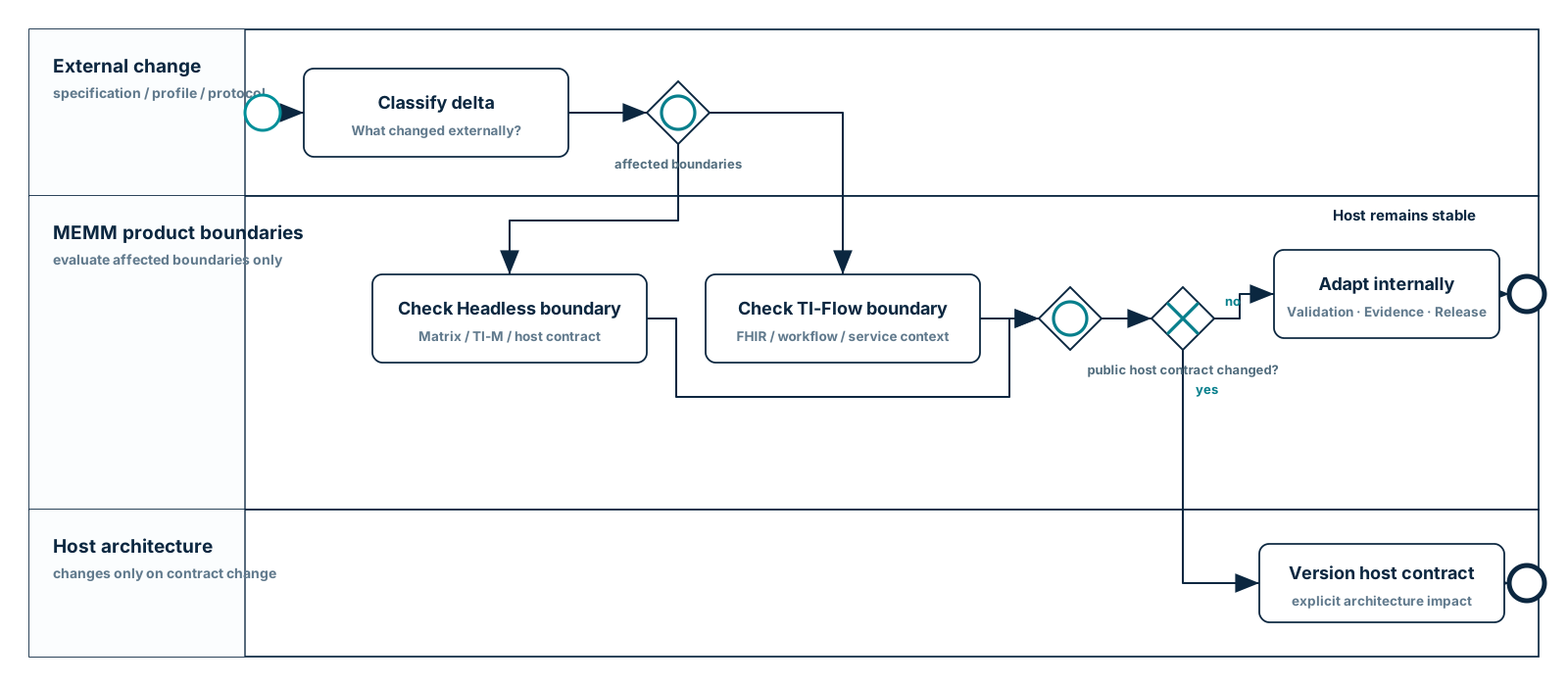
MEMM stays on the application side even when TI and external services change.

External specifications and infrastructure are reference context, not part of a blanket product promise. The product boundary therefore remains explicit.

TI 2.0 classification

Software-based access, identities and Zero Trust change the environment—not the ownership boundary.

MEMM places Headless, identity/policy and data/profile boundaries on the application side. TI-Gateway, ZETA and external identity services remain separate. Draft_TI-Messenger_26_2 is treated as a development reference, not a conformance commitment.

Read TI 2.0 architecture brief →
TI-Flow Engineering Foundation

Workflow placement and recoverable migration as a bounded technical foundation.

The implemented foundation separates stable workflow placement, shard-local transactions and failure containment from higher-level FHIR, HCC, ZETA and operational contracts. Draft_TI-Flow_26_2 remains an external development reference.

View TI-Flow foundation →
Integration pattern

How MEMM can sit inside an existing product landscape.

The patterns are technical orientations, not commitments to a specific delivery model. The concrete integration path is agreed per project, target system and release.

Existing systemsHealthcare applicationPlatform serviceBackend process
MEMM integration boundary
01
In-process / OEMPossible embedding along agreed API and runtime boundaries.
02
Platform servicePossible service-oriented integration with an explicitly named system boundary.
03
Controlled automationPossible processing of technical events and follow-up actions in the agreed scope.
External contextsCommunicationData profilesPolicy / Operations
01Versioned contractsChange states remain explicit.
02Explicit rejectionUnsupported inputs and states stay visible.
03Scope before useSupport is not inferred from marketing copy.
04Traceable changeRelease and evidence references stay version-bound.
Use & integration path

For teams that clarify product boundaries before the pilot.

MEMM is aimed at technical organizations that want interfaces, ownership and external prerequisites explicitly defined before integration.

01PVS / KIS / AVS & OEM

Place communication and workflow capabilities inside existing healthcare applications.

02Platforms & integrators

Treat versions, hand-off points and operational responsibility as explicit contracts.

03Insurers & contact centers

Evaluate automation and communication scenarios with a clear technical scope boundary.

View use context →
Scope before pilot
01Architecturetarget system and responsibility boundaries
02Evaluationbounded interfaces and scenarios
03Pilotrelease, environment and verification criteria
04Production scopeonly explicitly confirmed artifacts and operating boundaries
Classification: Matrix, FHIR®, TI, TI-M, TI-Flow, ZETA, ePA and gematik refer to external standards, infrastructures or integration contexts. This site does not claim certification, approval or commissioning by gematik or another authority. Supported profiles, versions and operational boundaries are confirmed in writing before use.
Matrix Conference 2026 · independent topic brief

A technical entry point for Matrix, Headless and Digital Health topics around the 2026 conference.

The Matrix Conference 2026 takes place in Malmö, Sweden, from 20–23 October 2026. MEMM uses the event only as an external context for a topic brief that connects the Headless product boundary, R1001 evidence and integration model. Conference submissions related to this product line are still under review; this site does not claim an accepted talk, speaker role, sponsorship, endorsement or organizer affiliation.

Open independent topic brief →Official conference site ↗
Synthetic UI concepts

Technical complexity needs a shared visual language.

These views are design studies with fully synthetic data. They illustrate possible roles and interaction concepts—not a customer environment, measured performance or production status.

Concept UI · synthetic data
Platform view

Component overview

Illustrative console view for modules, integrations, status classes and open review points.

Concept UI
Workflow view

Workflow & TI-Flow

Concept UI
Headless view

Operations

All names, states, values and datasets shown in the concept views are synthetic and do not establish availability, performance, conformance or certification.

Open all concept views
Next useful step

Do not start with a demo. Start with the integration scope.

A first technical conversation can clarify target system, development state, responsibility boundaries, verification needs and a bounded evaluation scope.